 Sodate
On this page
Domino is a plain peace lily with white variegation, and that one change cascades through its care. Less chlorophyll means it needs noticeably brighter indirect light than a standard peace lily, grows roughly a third slower, flowers less freely, and reverts to solid green in dim rooms. It costs about two to three times a plain peace lily and is toxic to cats and dogs, exactly like the base species. Base guide: Peace Lily.
Key facts
- Domino is chimeral variegation, meaning the white tissue is a genetically distinct cell layer. It does not come true from seed and can be lost permanently if the plant reverts and you leave the green shoots in place.
- Because roughly a quarter to a third of each leaf carries no chlorophyll, Domino needs materially more light than a plain peace lily, which is famously the plant that copes with dark offices.
- The white sectors scorch before green tissue does, so Domino is simultaneously less shade-tolerant and less sun-tolerant than the base species. Its usable light window is narrower.
- Toxicity is unchanged from the base species: calcium oxalate crystals make it toxic to cats, dogs and humans if chewed.
Care requirements (and how they differ from a plain peace lily)#
| Plant type | Indoor variegated foliage cultivar of Spathiphyllum, an aroid |
| Base species page | Peace Lily (Spathiphyllum wallisii). Read this for the underlying species care |
| Growing medium | Same as the base species: peat-free houseplant mix with perlite for aeration |
| Light needs | Bright indirect light, the key difference. A plain peace lily tolerates a dim corner; Domino loses its variegation there and must sit near a bright window without direct sun |
| Water frequency | Every 5-8 days, slightly less often than a plain peace lily because slower growth means slower water use. It still wilts theatrically when thirsty and recovers within hours |
| Water quality | Sensitive to fluoride and chlorine like the base species; filtered or rainwater reduces brown tipping, and the pale sectors show tipping more visibly |
| Humidity | 50%+ preferred; the white sectors crisp at the edges sooner than green tissue in dry air |
| Temperature range | 18-27°C (65-80°F); no cold draughts |
| Fertilizer | Half-strength balanced liquid feed monthly in spring and summer. Avoid high-nitrogen feeds, which push green growth and dilute the variegation |
| Soil pH | 5.8-6.5 |
| Drainage needs | High: Domino is less vigorous than the base species and recovers from root rot more slowly |
| Flowering | Fewer and often smaller white spathes than a plain peace lily, because less photosynthetic tissue means less energy for flowering |
| Toxicity | Toxic to cats, dogs and humans. Insoluble calcium oxalate causes mouth burning, drooling and swelling. Identical to the base species |
Growth, reversion & propagation#
| Mature size | 40-60cm tall and wide. Noticeably more compact than a standard peace lily, which reaches 60-90cm |
| Growth rate | Slow to moderate; roughly a third slower than a plain peace lily |
| Reversion risk | High in low light. Shoots producing entirely dark green leaves are reverted growth and will outcompete the variegated crowns if not removed |
| Propagation methods | Division only. Separate a crown that already carries good variegation. Seed and reverted divisions will not reproduce the Domino pattern |
| Propagation difficulty | Intermediate; divisions establish more slowly than plain peace lily divisions |
| Repotting schedule | Every 2 years in spring, one size up only. An oversized pot stays wet and this cultivar rots more readily |
Common problems & troubleshooting#
| Symptom | Likely cause | Fix |
|---|---|---|
| New leaves emerging solid dark green with no white | Reversion driven by insufficient light. The Domino-specific failure mode | Move to bright indirect light and cut the reverted crown out at the base; green growth is more vigorous and will take the plant over if left |
| White sectors turn papery brown while green areas stay fine | Sun scorch. Unpigmented tissue burns first | Move out of direct sun; bright indirect is the target, not a sunny sill |
| Plant flowers far less than a plain peace lily used to | Normal for Domino. Reduced chlorophyll means less energy available for spathes | Maximise light within the indirect range and feed at half strength monthly in the growing season; expect fewer flowers regardless |
| Brown leaf tips, more obvious on the pale sections | Fluoride and chlorine in tap water plus low humidity | Switch to filtered or rainwater and raise humidity above 50% |
| Dramatic total collapse of every leaf | Underwatering. Peace lilies wilt hard before they die | Water thoroughly; it usually recovers within a few hours, though repeated collapses cause permanent leaf damage |
Variegation lives or dies by light
Sodate measures your actual light level and flags when Domino is sitting in the range where it quietly reverts to plain green.
Seasonal care#
Varieties & cultivars#
| Variety | Distinguishing trait | Note |
|---|---|---|
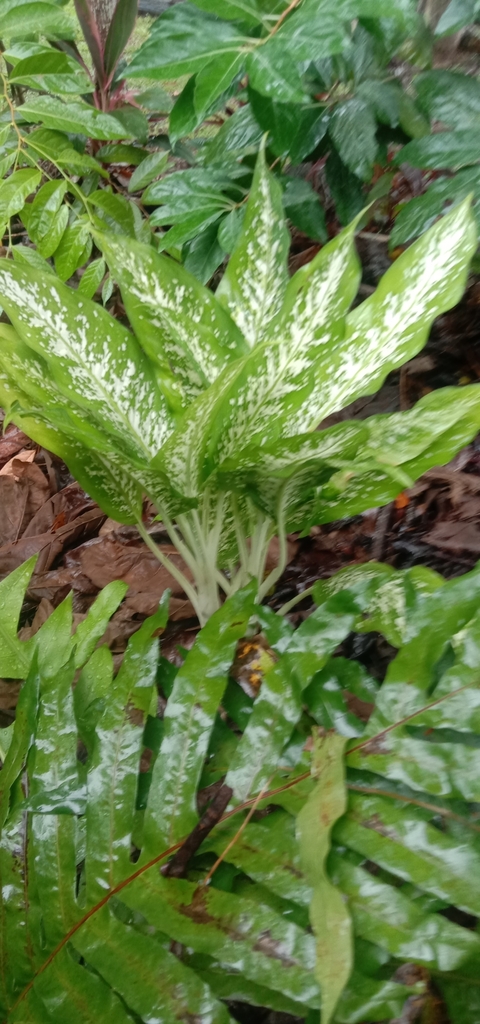
| Spathiphyllum 'Domino' (this plant) | Irregular white and cream speckling across dark green leaves | The mainstream variegated peace lily |
| Spathiphyllum wallisii (plain) | Solid green leaves, free-flowering, shade-tolerant | Cheaper, faster and much more forgiving. See the base guide |
| Spathiphyllum 'Sensation' | Huge ribbed green leaves up to 1.2m tall | The largest common peace lily; not variegated |
| Spathiphyllum 'Picasso' | Bold white half-leaf blocking rather than fine speckles | Rarer, more expensive and even more prone to reversion than Domino |
Buying checklist#
- Variegation is distributed across most leaves, not confined to one or two. A mostly-green plant is already reverting
- White sectors are clean cream-white, not browned or scorched at the edges
- Check for an entirely green shoot at the base; you will have to cut it out
- Crown is firm at soil level with no soft, dark tissue
- Compare the price against a plain peace lily on the same bench. If it is barely more, question whether it is really Domino
Pricing by region#
| Region | Price range | Typical unit | Basis |
|---|---|---|---|
| US | $18 – $45 | 6in pot | Nursery + online plant shop retail |
| UK | $16 – $40 | 14-17cm pot | Garden centre retail |
| India | $6 – $18 | 6in pot | Urban nursery retail |
| Australia | $20 – $48 | 175mm pot | Nursery retail |
| Canada | $19 – $45 | 6in pot | Garden centre retail |
USD figures are approximate conversions for comparison; switch the dropdown to see each region's actual local-currency listing price.
Often confused with#
Name confusion warning#
'Domino' is sometimes used loosely by retailers for any speckled peace lily, including 'Picasso' and unnamed variegated seedlings. Buy on what the plant actually looks like rather than the label.
Where it's actually grown#
Domino is tissue-cultured commercially in the Netherlands, Costa Rica and Southeast Asia and finished by regional growers. Tissue culture of chimeral variegation is inherently inefficient, since a proportion of plantlets emerge plain green and get culled. Which is a large part of why Domino costs multiples of a plain peace lily.
Import & biosecurity restrictions#
| Region | Note |
|---|---|
| Australia | Live plant imports restricted under biosecurity law; buy from domestic tissue-culture growers. |
| US | Domestic sale unrestricted; imports need a USDA phytosanitary certificate. |
| UK | Plant health certificates required for imports; domestic sale unrestricted. |
| India | No restriction; strong indoor light is easy to find, but keep it out of direct sun as the white sectors scorch fast. |
| Canada | CFIA import permit required for commercial imports; domestic sale unrestricted. |
Similar plants
Did you know?
Frequently asked questions
How is Peace Lily Domino different from a normal peace lily?
Domino has white and cream speckled leaves, needs noticeably brighter indirect light, grows around a third slower, flowers less freely, stays more compact, and costs two to three times as much.
Why is my Domino peace lily turning all green?
It is reverting because of low light. Move it to bright indirect light and cut out any shoot producing entirely green leaves before it takes over the plant.
Is Peace Lily Domino toxic to cats and dogs?
Yes, exactly like a standard peace lily. It contains insoluble calcium oxalate crystals that cause mouth burning, drooling and swelling if chewed.
Does Domino flower as much as a regular peace lily?
No. Reduced chlorophyll means less energy for flowering, so expect fewer and often smaller white spathes than the plain species produces.
Can I propagate Peace Lily Domino from seed?
No. The variegation is chimeral and does not come true from seed. Propagate only by dividing a crown that already carries good white variegation.