 Sodate
On this page
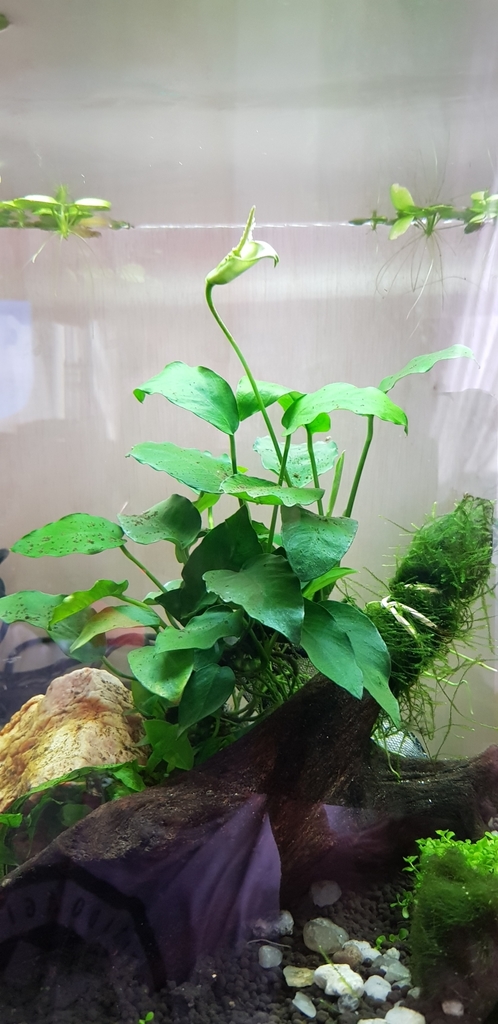
The one thing that matters: never bury the rhizome. Anubias is tied or glued to rock or driftwood with the thick horizontal rhizome fully exposed to the water. Bury it in gravel or sand and it rots and the plant dies. It is extremely slow-growing and needs very little light, which also makes it the most algae-prone plant in a bright tank. Safe for fish, shrimp and pets. Typically $6-$25.
Key facts
- The rhizome must never be buried. Attach the plant to rock or driftwood with the rhizome fully in open water, or it rots.
- Growth is very slow: a healthy plant may produce only one new leaf a month.
- It thrives in low light, and bright light mostly just grows algae on its slow, long-lived leaves.
- The leathery leaves are tough enough that goldfish and most cichlids ignore them, unlike softer aquarium plants.
- Non-toxic in the aquarium context and safe around fish, shrimp and household pets; like other aroids it is not intended for eating.
Care requirements#
| Plant type | Submerged or emersed aquatic aroid, attached to hardscape, never planted in substrate |
| Attachment substrate | Driftwood, lava rock, slate, or a stainless mesh; tie with cotton thread or fishing line, or use cyanoacrylate gel |
| Rhizome rule | The horizontal rhizome must sit fully exposed in the water; only the roots may touch or grip the hardscape |
| Light needs | Low: 10-30 PAR is plenty; higher light causes algae on the leaves rather than faster growth |
| Water flow | Gentle to moderate flow across the leaves helps keep detritus and algae off |
| Water temperature | 22-28°C (72-82°F); tolerates a wide range and cooler goldfish tanks |
| Water hardness and pH | Very tolerant across soft to hard water and pH 6.0-8.0 |
| CO2 | Not required; it grows slightly faster with CO2 but remains slow either way |
| Fertilizer | Liquid water-column fertiliser only. Root tabs are useless because the roots are not in substrate |
| Algae management | Keep light low and duration short, and add algae-eating shrimp or otocinclus; wipe stubborn spot algae off leaves by hand |
| Emersed growing | Also grows out of water in a paludarium with high humidity and the rhizome resting on damp hardscape |
| Toxicity | Safe with fish, shrimp and snails; as an aroid it contains calcium oxalate and should not be eaten by pets or people |
Growth & propagation#
| Mature size | 10-40cm depending on species; A. barteri var. nana stays under 10cm |
| Growth rate | Very slow. Roughly one new leaf per month in a healthy tank |
| Propagation methods | Cut the rhizome into sections with at least three leaves each, then attach each piece to new hardscape |
| Propagation difficulty | Easy: a clean cut with a sharp blade is all it takes |
| Flowering | Produces a small white aroid spathe underwater or emersed; harmless and can be trimmed |
| Pruning needs | Remove old algae-covered or damaged leaves at the rhizome; never trim the rhizome itself except to divide |
Common problems & troubleshooting#
| Symptom | Likely cause | Fix |
|---|---|---|
| Rhizome turns soft, brown and mushy and leaves fall off | The rhizome was buried in substrate, so it could not get oxygen | Lift the plant immediately, cut back to firm white tissue, and reattach to rock or wood with the rhizome fully exposed |
| Leaves covered in hard green spot algae | Too much light for a plant that grows too slowly to outcompete algae | Reduce light intensity and photoperiod, increase flow, add otocinclus or nerite snails, and scrape spots off manually |
| Leaves melt and turn translucent after purchase | Transition shock from emersed nursery growth to submerged tank conditions | Normal. Remove melted leaves and wait; the rhizome will push out true submerged leaves over the following weeks |
| Yellowing leaves with no new growth | Nutrient deficiency in the water column, since it cannot feed from substrate | Dose a complete liquid aquarium fertiliser regularly |
| Plant floats loose and drifts around the tank | Thread rotted or glue failed before roots gripped the hardscape | Reattach with fishing line or gel superglue on the roots and lower rhizome only, and leave it several months to grip |
A plant that grows this slowly still needs checking
Sodate tracks tank maintenance and algae checks so a slow grower does not quietly disappear under green film.
Seasonal care#
Varieties & cultivars#
| Variety | Distinguishing trait | Note |
|---|---|---|
| Anubias barteri var. nana | Compact, under 10cm, the aquarium standard | The most widely sold and most forgiving |
| Anubias barteri var. nana 'Petite' | Tiny leaves under 2cm | Popular for nano tanks and foreground stones |
| Anubias barteri (standard) | Large broad leaves to 30cm+ | Good background plant on large driftwood |
| Anubias 'Coffeefolia' | Bronze, heavily corrugated new leaves | Slower and pricier than plain nana |
Buying checklist#
- Rhizome is firm and pale green, not soft, dark or smelly
- Several healthy leaves with intact leaf stalks
- White or pale roots present. Brown mush means it was kept buried
- Check for and remove any rockwool or pot the nursery grew it in
Pricing by region#
| Region | Price range | Typical unit | Basis |
|---|---|---|---|
| US | $6 – $25 | portion or wood-attached piece | Aquarium store + online |
| UK | $7 – $28 | portion or attached piece | Aquatic retail |
| India | $2 – $9 | portion | Aquarium shops + online |
| Australia | $8 – $30 | portion or attached piece | Aquarium retail |
| Canada | $8 – $28 | portion or attached piece | Aquarium store + online |
USD figures are approximate conversions for comparison; switch the dropdown to see each region's actual local-currency listing price.
Often confused with#
Where it's actually grown#
Almost all aquarium anubias is nursery-grown emersed in greenhouses in Southeast Asia, Sri Lanka, Denmark and Florida, or produced as sterile tissue culture; wild West African collection is now rare in the trade.
Import & biosecurity restrictions#
| Region | Note |
|---|---|
| Australia | Live plant imports restricted under biosecurity law; Anubias barteri is permitted and available domestically, but check the current permitted-species list. |
| US | No federal restriction; anubias is not listed as a noxious aquatic weed and is widely sold. |
| UK | Imports need phytosanitary paperwork; freely sold in aquatic shops. |
| India | No specific restriction; widely available through aquarium retailers. |
| Canada | CFIA import requirements apply to commercial shipments; retail sale is unrestricted. |
Similar plants
Did you know?
Frequently asked questions
Can I plant anubias in aquarium substrate?
No. Burying the rhizome cuts off oxygen and rots the plant. Tie or glue it to rock or driftwood with the rhizome fully exposed and only the roots touching the hardscape.
Why is my anubias covered in algae?
It grows too slowly to outgrow algae in bright tanks. Reduce light intensity and photoperiod, improve flow, and add algae eaters such as nerite snails or otocinclus.
How fast does anubias grow?
Very slowly. Often just one new leaf a month, even in good conditions. This is normal and not a sign of a problem.
Does anubias need CO2 or special lighting?
No. It thrives in low light with no CO2, which is why it is a staple of low-tech tanks.
Is anubias safe for fish and shrimp?
Yes, it is safe in the aquarium and its tough leaves resist grazing. As an aroid it should not be eaten by pets or people.