 Sodate
On this page
Grow a staghorn mounted on a board over sphagnum moss, in bright indirect light. Water by taking it off the wall and dunking the moss pad for 10-20 minutes when it feels light and dry. Roughly weekly in summer, every 2-3 weeks in winter. Never remove the brown shield fronds (they're supposed to go brown), and never wipe the felt off the antler fronds. Pet-safe. $15-$60 mounted.
Key facts
- An epiphyte from eastern Australia and New Guinea rainforests. The roots exist to cling to bark, so a potted staghorn in dense soil usually rots.
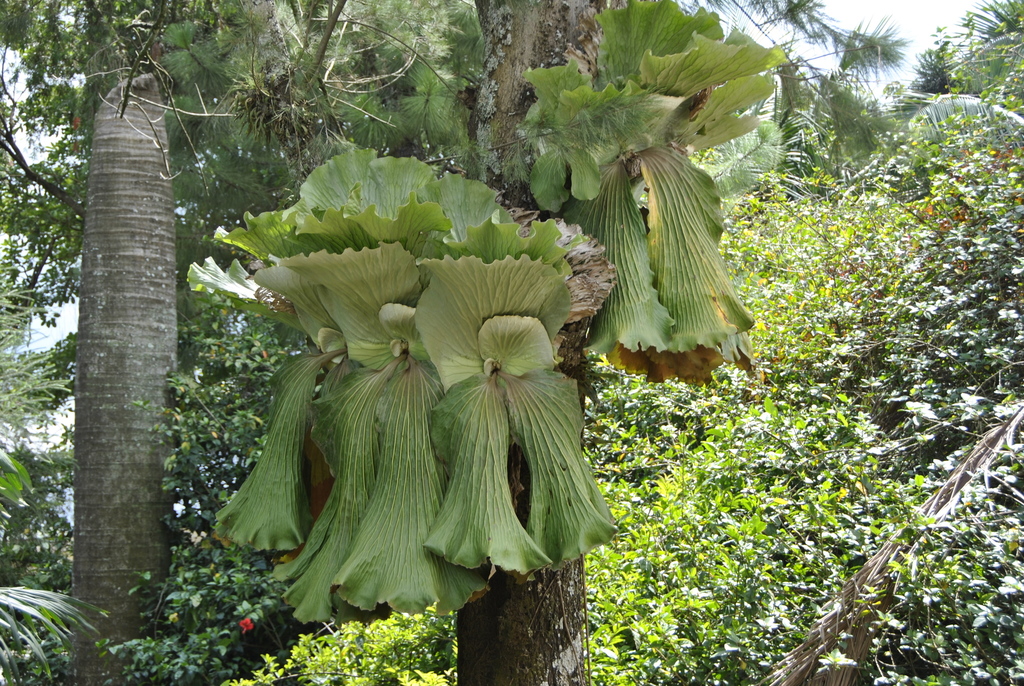
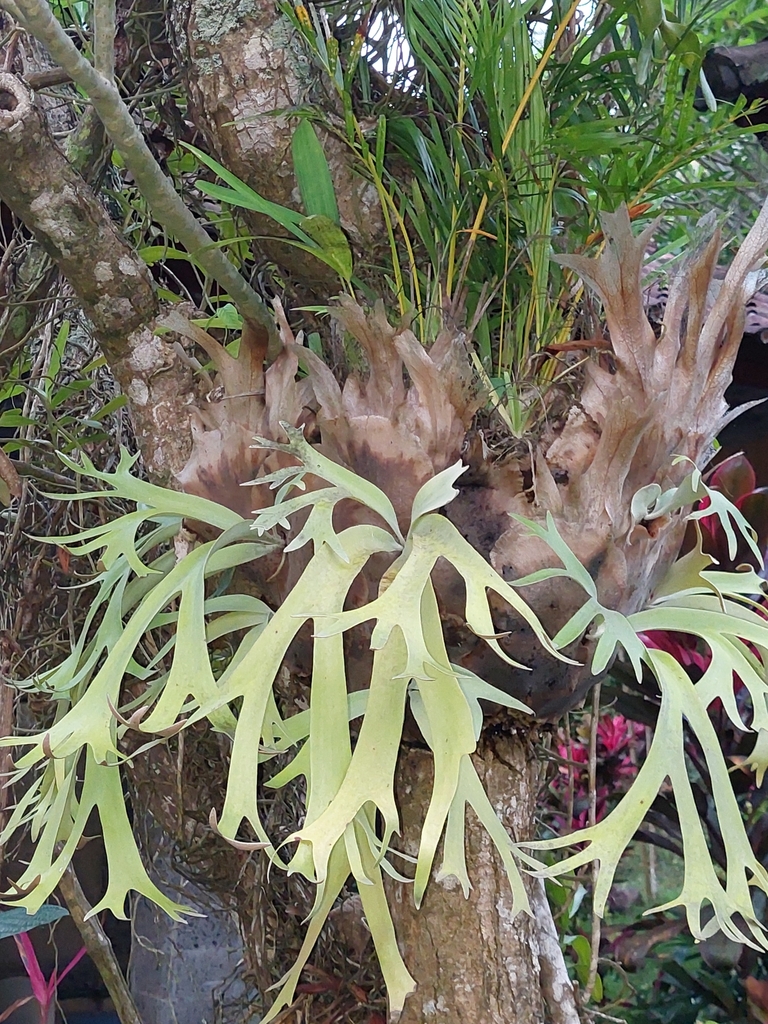
- It grows two kinds of fronds: flat round shield fronds that clasp the mount and naturally turn brown and papery, and green antler-shaped fertile fronds.
- The white felt on the antler fronds is a layer of protective hairs that reduces water loss. Wiping it off as 'dust' harms the plant.
- P. bifurcatum is the hardiest and easiest staghorn, pupping freely into large colonies.
- Non-toxic to cats and dogs.
Care requirements#
| Plant type | Epiphytic fern (indoor/patio; outdoors year-round in USDA 9-11) |
| Growing medium | Mounted: a pad of sphagnum moss (or moss + a little orchid bark) strapped to a wood board, cork, or basket, not potting soil |
| Light needs | Bright indirect light; gentle morning sun is fine, hot afternoon sun scorches fronds |
| Watering method | Take the mount down and soak/dunk the moss pad 10-20 minutes, or run tepid water through it; rehang once it stops dripping |
| Watering frequency | Weekly in warm weather, every 2-3 weeks in winter. Judge by weight: light and dry means water |
| Misting | Mist antler fronds between dunks in dry rooms, but misting alone never replaces soaking the moss |
| Humidity | 50%+ preferred; bathrooms and covered patios are ideal |
| Air circulation | Good airflow keeps the shield fronds from rotting against the mount |
| Temperature range | 16-30°C (60-86°F); established plants tolerate brief dips to around 0°C (32°F) |
| Fertilizer | Balanced liquid feed at 1/2 strength monthly in spring-summer; banana peels tucked behind the shield are folk tradition, a diluted feed works better |
| Remounting | Every 2-4 years or when pups crowd the board. Strap fresh moss and the root mass to a larger board |
| Toxicity | Non-toxic to cats, dogs, and humans |
Growth & propagation#
| Mature size | 60-90cm across on a mature mounted colony; wild colonies exceed 1m |
| Growth rate | Moderate: a few new fronds per season |
| Frond types | Brown papery shield fronds hug the mount; green antler fronds arch outward and carry spores |
| Propagation methods | Pups form beside the parent. Cut away with a knife, keeping some shield and roots, and mount on fresh moss |
| Propagation difficulty | Moderate: pups establish reliably if kept humid for the first month |
| Pruning needs | None; never cut off brown shield fronds, only fully dead antler fronds |
Common problems & troubleshooting#
| Symptom | Likely cause | Fix |
|---|---|---|
| Black soft patches at the base behind the shield fronds | Rot from watering too often or moss never drying | Let the pad dry out fully, improve airflow, and lengthen the watering interval; remount into fresh moss if the rot smells sour |
| Antler fronds wilt and the moss pad feels feather-light | The pad dried out completely. Mist-only watering is the usual culprit | Dunk the whole mount for 30-60 minutes; switch from misting to regular soaking |
| Shield fronds turning brown | Completely normal. Shields are designed to brown and paper over | Do nothing; removing them exposes and damages the root zone |
| White felt gone, fronds turning dark where touched | Someone wiped the 'dust' off the fronds | Stop cleaning the fronds; the felt regrows only on new fronds |
| Fuzzy grey-brown scale insects along frond undersides | Fern scale infestation (often confused with the natural spore patches) | Spore patches are neat brown blocks under antler tips; scattered individual bumps are scale. Dab with 70% alcohol, avoid oil sprays which staghorns resent |
Dunk on schedule, not on guesswork
Sodate learns your staghorn's dry-out rhythm across seasons so the moss pad never stays soggy or bone dry.
Seasonal care#
Varieties & cultivars#
| Variety | Distinguishing trait | Note |
|---|---|---|
| P. bifurcatum 'Netherlands' | Compact, upright, fast-pupping form | The standard greenhouse variety sold in most shops |
| P. bifurcatum ssp. veitchii (silver staghorn) | Silvery, felted, more upright fronds; higher light tolerance | Often sold as its own species |
| P. bifurcatum 'Majus' | Longer, more erect antler fronds | Collector form |
Buying checklist#
- Firm green antler fronds with intact white felt, not limp or dark-spotted
- Shield fronds hugging the medium tightly (brown is fine, mushy is not)
- If potted, plan to mount it. Check the crown isn't buried deep in wet soil
- For mounted plants, the moss pad should be secure and the board free of mold
Pricing by region#
| Region | Price range | Typical unit | Basis |
|---|---|---|---|
| US | $15 – $60 | mounted board (potted from $10) | Nursery + online retail |
| UK | $15 – $57 | mounted or potted | Garden centre + specialist |
| India | $5 – $18 | potted or mounted | Urban nursery + online |
| Australia | $13 – $52 | mounted board | Nursery retail (native plant, widely grown) |
| Canada | $15 – $55 | mounted or potted | Garden centre + online |
USD figures are approximate conversions for comparison; switch the dropdown to see each region's actual local-currency listing price.
Often confused with#
Name confusion warning#
'Staghorn' vs 'elkhorn' flips by country. In Australia, P. bifurcatum is called elkhorn and the giant P. superbum is the staghorn. The reverse of common US usage. Check the botanical name when buying.
Where it's actually grown#
Nearly all retail staghorns are greenhouse-raised P. bifurcatum from spore or tissue culture in Florida, the Netherlands, and Southeast Asia; in Australia they're also propagated from pups of garden colonies. Wild collection is prohibited in New South Wales, where the species is protected.
Import & biosecurity restrictions#
| Region | Note |
|---|---|
| US | No restriction on domestic sale; Florida-grown stock dominates. |
| UK | No specific restriction; imports need standard phytosanitary certificates. |
| Australia | Live plant imports restricted under biosecurity law. Irrelevant in practice, as it's a protected native grown domestically; don't collect from the wild. |
| India | No specific restriction; increasingly common in urban nurseries. |
| Canada | CFIA permits required for commercial imports; sold as a houseplant. |
Similar plants
Ranked in these guides
Did you know?
Frequently asked questions
Is a staghorn fern safe for cats and dogs?
Yes. Platycerium bifurcatum is non-toxic to cats and dogs.
Should I remove the brown fronds on my staghorn fern?
Not the round ones at the base. Those shield fronds are meant to turn brown and papery, and they protect the roots. Only remove fully dead green (antler) fronds.
How do I water a mounted staghorn fern?
Take the mount down and dunk the moss pad in water for 10-20 minutes, then rehang once it stops dripping. Weekly in summer, every 2-3 weeks in winter, judging by weight.
Can a staghorn fern grow in a pot?
Young plants tolerate a very airy orchid-bark mix for a while, but it's an epiphyte. Mounted on a board over sphagnum is how it's meant to grow, and buried crowns in regular soil tend to rot.
How do I propagate a staghorn fern?
Cut a pup from the colony with a sharp knife, keeping a piece of shield frond and some roots, then strap it to a new board over damp sphagnum and keep it humid for a month.