 Sodate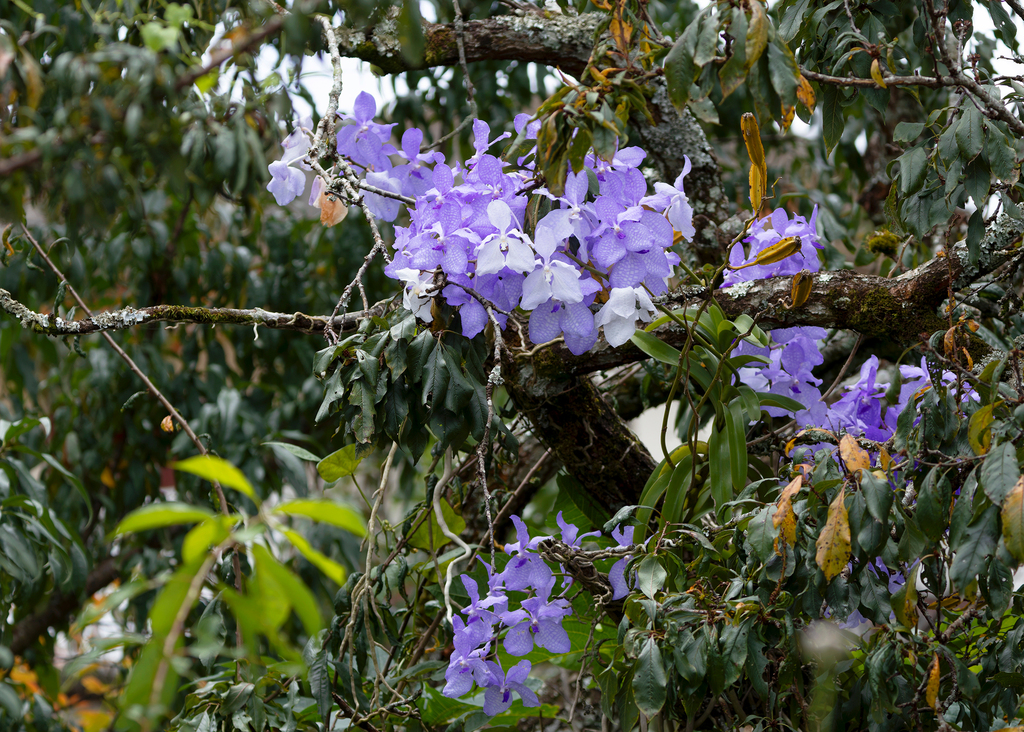
On this page
Vandas are grown hanging bare-root in slat baskets with no medium at all. They need the highest light of the common orchids (short of direct midday sun), watering close to daily in warm weather, weak fertiliser at almost every watering, and constant air movement so the roots dry within an hour or two. Pet-safe. Typically $25-$80.
Key facts
- Vandas are grown with no potting medium at all. Bare roots hanging from a teak or plastic slat basket.
- They need the highest light of the commonly grown orchids, far more than a phalaenopsis will tolerate.
- Watering is near-daily in warm weather; the thick spongy velamen on the roots turns from silver-white to green when hydrated.
- Roots must dry out again within a couple of hours, which is why constant airflow matters as much as the water itself.
- Non-toxic to cats and dogs, like other orchids.
Care requirements#
| Plant type | Epiphytic orchid grown bare-root; outdoors year-round only in USDA 10-12 |
| Growing medium | None: hung bare-root in an open teak or plastic slat basket; some growers add a few coarse charcoal chunks only |
| Light needs | Very bright, the highest of the common orchids; direct early morning and late afternoon sun is welcome, filter harsh midday sun |
| Watering method | Drench the roots thoroughly with a hose or under a tap until the velamen turns green, or dunk the basket for 10-15 minutes |
| Soak-vs-mist schedule | Water daily in warm growing weather, every 2-3 days in cool or dim conditions; misting alone is not enough for a mature plant |
| Drying window | Roots should return to silver-white within 1-2 hours; if they stay green and wet all day, airflow is inadequate |
| Air circulation | Critical: hang where air moves freely; a still, humid corner causes root and crown rot |
| Humidity | 60-80% ideal; in dry homes water more often rather than trapping humidity around the plant |
| Temperature range | 18-35°C (65-95°F) for standard hybrids; keep above 13°C (55°F) |
| Fertilizer | Weak orchid feed at roughly quarter strength at most waterings during growth, with a plain-water flush weekly |
| Support | Hang the basket so the roots dangle free and are never crushed against a wall or shelf |
| Toxicity | Non-toxic to cats, dogs, and humans |
Growth & propagation#
| Mature size | 40-90cm tall with roots trailing a metre or more below the basket |
| Growth rate | Moderate: a strap-leaf vanda adds several leaf pairs a year in good light |
| Flowering | One to three flushes a year in strong light, each lasting two to six weeks |
| Propagation methods | Keikis (basal offshoots) or topping a tall plant once the upper section has its own roots |
| Propagation difficulty | Moderate: the cut section must carry several healthy roots |
| Pruning needs | Cut spent flower spikes at the base; trim only roots that are dead, hollow and brown |
Common problems & troubleshooting#
| Symptom | Likely cause | Fix |
|---|---|---|
| Roots stay silver and shrivelled, leaves wrinkle | Under-watering. The commonest vanda failure, especially indoors | Water daily and dunk the roots for 10-15 minutes until the velamen greens up on contact |
| Leaves green and lush but no flowers for a year | Not enough light; vandas flower on high light | Move to the brightest spot available or add a strong grow light; a sunroom or bright south window is about right |
| Black soft rot in the crown between the top leaves | Water sitting in the crown overnight without airflow | Water in the morning, tip out standing water, and improve air movement; cut out rotten tissue and treat with cinnamon or a fungicide |
| Lower leaves yellow and drop in sequence | Natural leaf shed if slow, or root loss if rapid | Check the roots; if many are hollow and papery, rebuild the root system with daily watering and higher humidity |
| Leaf tips brown and dry back | Salt build-up from fertilising at every watering without flushing | Flush with plain water weekly and drop the feed to quarter strength |
A daily-watered orchid needs a real routine
Sodate builds the watering and feeding rhythm around your season and light, so a vanda's roots never sit silver for days.
Seasonal care#
Varieties & cultivars#
| Variety | Distinguishing trait | Note |
|---|---|---|
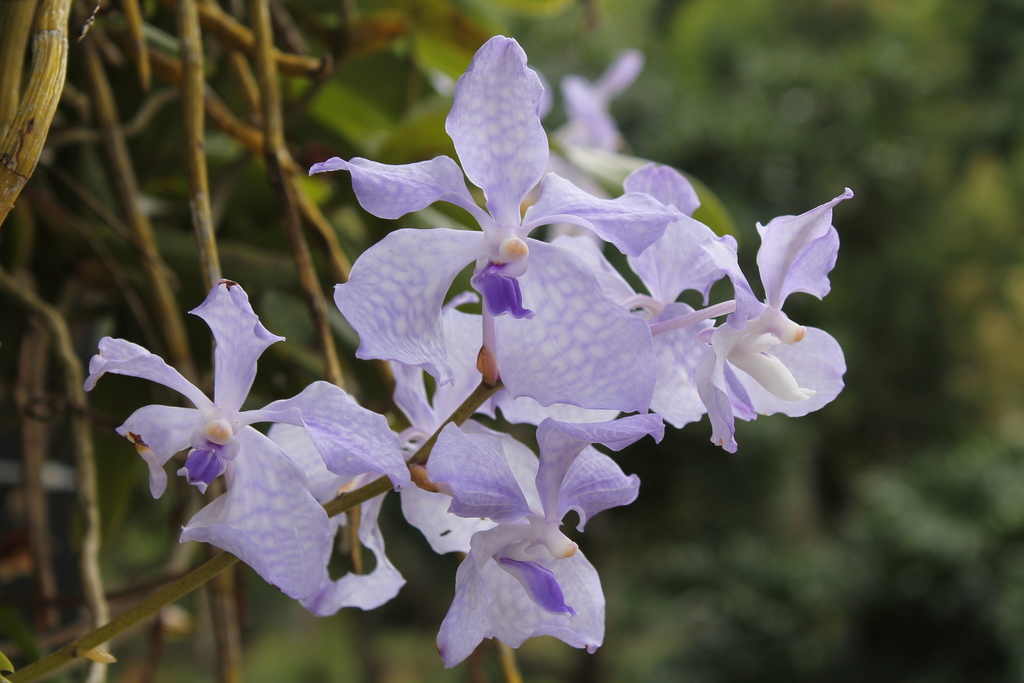
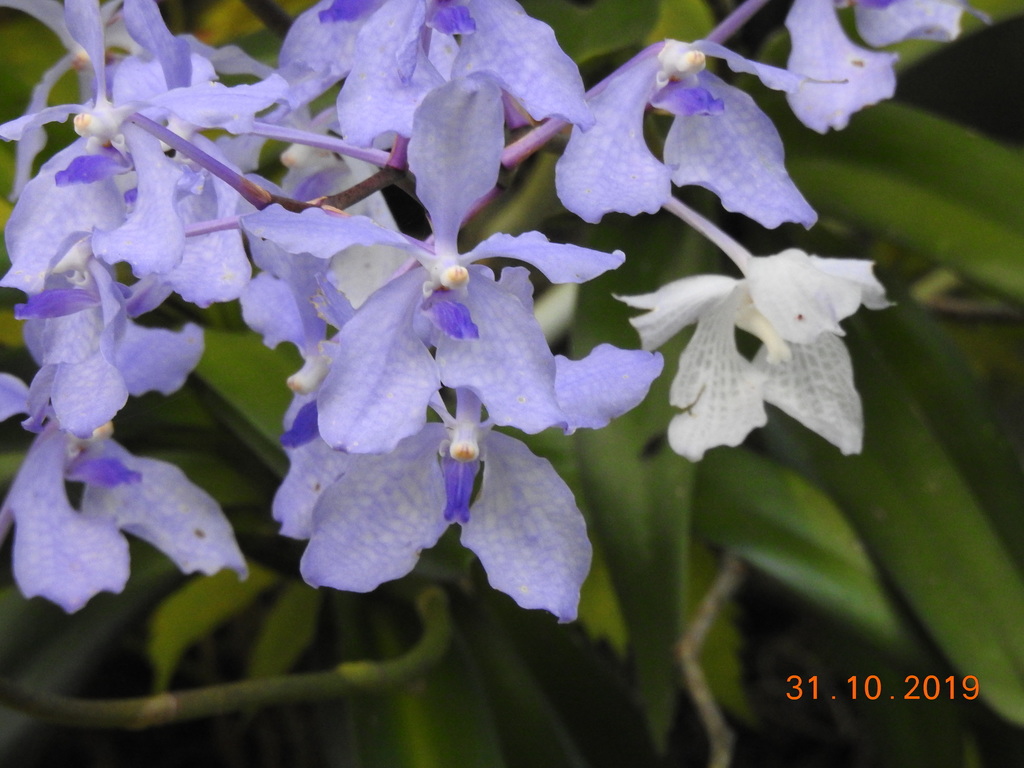
| Strap-leaf vandas (V. coerulea types) | Broad flat leaves, large flat blue or violet flowers | The classic showy group; needs the most light and water |
| Terete-leaf vandas | Pencil-round leaves, extremely sun-tolerant | Grown outdoors in the tropics; too light-hungry for most homes |
| Semi-terete hybrids | Intermediate leaf shape and light needs | A more forgiving compromise for home growers |
| Vanda (Ascocenda) hybrids | Compact plants with smaller, abundant flowers | The best choice for limited space |
Buying checklist#
- Plenty of fat, firm, silvery-green roots. Root mass matters more than leaf count
- Leaves are stiff and evenly spaced, not wrinkled or accordion-pleated from past drought
- No black soft tissue in the crown between the top leaves
- Basket is open-slatted and the roots hang free rather than being packed in bark
Pricing by region#
| Region | Price range | Typical unit | Basis |
|---|---|---|---|
| US | $25 – $80 | blooming-size plant in basket | Orchid nursery + online |
| UK | $30 – $90 | blooming-size plant | Specialist orchid nursery |
| India | $6 – $30 | blooming-size plant | Orchid nurseries (locally grown) |
| Australia | $25 – $75 | blooming-size plant | Orchid specialist retail |
| Canada | $30 – $90 | blooming-size plant | Orchid nursery + online |
USD figures are approximate conversions for comparison; switch the dropdown to see each region's actual local-currency listing price.
Often confused with#
Name confusion warning#
Many plants sold as 'Ascocenda' have been reclassified into Vanda; the care is identical, so treat an Ascocenda label as a compact vanda.
Where it's actually grown#
Commercial vandas are mass-produced by orchid nurseries in Thailand, Taiwan and Singapore, plus Florida and Hawaii for the North American market; virtually all retail plants are nursery hybrids rather than wild species.
Import & biosecurity restrictions#
| Region | Note |
|---|---|
| Australia | Live plant imports restricted under biosecurity law; buy from domestic orchid nurseries. |
| US | All orchids are CITES-listed; imports need CITES paperwork, but nursery-propagated hybrids sold domestically are unrestricted. |
| UK | CITES documentation required for import; widely available from domestic orchid specialists. |
| India | No restriction on domestic sale; vandas are commercially grown in the northeast and in Kerala. |
| Canada | CITES permits plus CFIA import requirements apply; retail plants are unrestricted. |
Similar plants
Ranked in these guides
Did you know?
Frequently asked questions
Why are vanda orchids grown with no potting mix?
Their thick aerial roots are adapted to hang free in tropical air, absorbing water in bursts and drying within hours; any medium holds water against them and causes rot.
How often do you water a vanda orchid?
Close to daily in warm growing weather, every two to three days in cool or dim conditions. The roots should turn green when watered and silver again within a couple of hours.
Are vanda orchids pet-safe?
Yes, vandas and orchids generally are non-toxic to cats and dogs.
Why won't my vanda bloom?
Almost always insufficient light. Vandas need the brightest position of any common orchid, close to unfiltered morning sun.
How much does a vanda orchid cost?
A blooming-size plant in a basket typically costs $25-$80 in the US, with true-blue and awarded clones costing much more.