 Sodate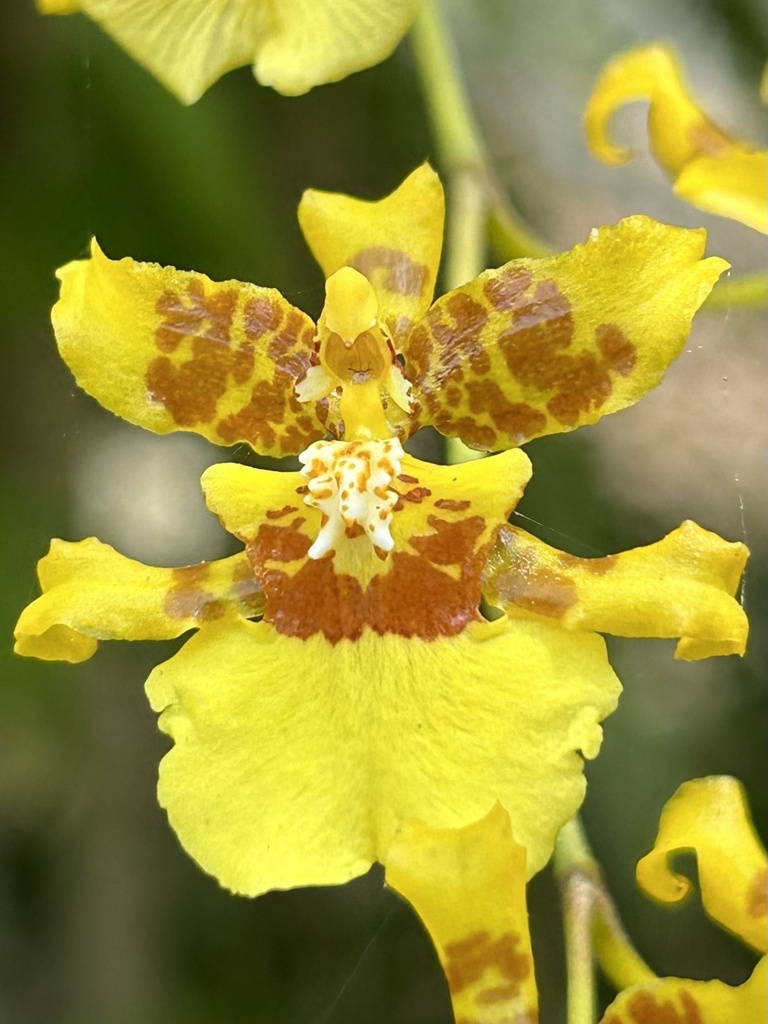
On this page
Oncidiums have much finer roots than a cattleya, so a mount dries out fast and watering needs to be frequent and light: drench daily or every other day in growth, less in winter. Mount on cork or tree fern with a modest sphagnum pad, give bright indirect light and 50-70% humidity, and watch for accordion-pleated new leaves, the classic sign the plant went thirsty. Pet-safe. Typically $20-$60.
Key facts
- Oncidium roots are fine and thin compared with a cattleya's, so a mount dries out fast and needs frequent, lighter watering.
- Pleated, accordion-like new leaves are the signature symptom of a plant that dried out while that growth was forming.
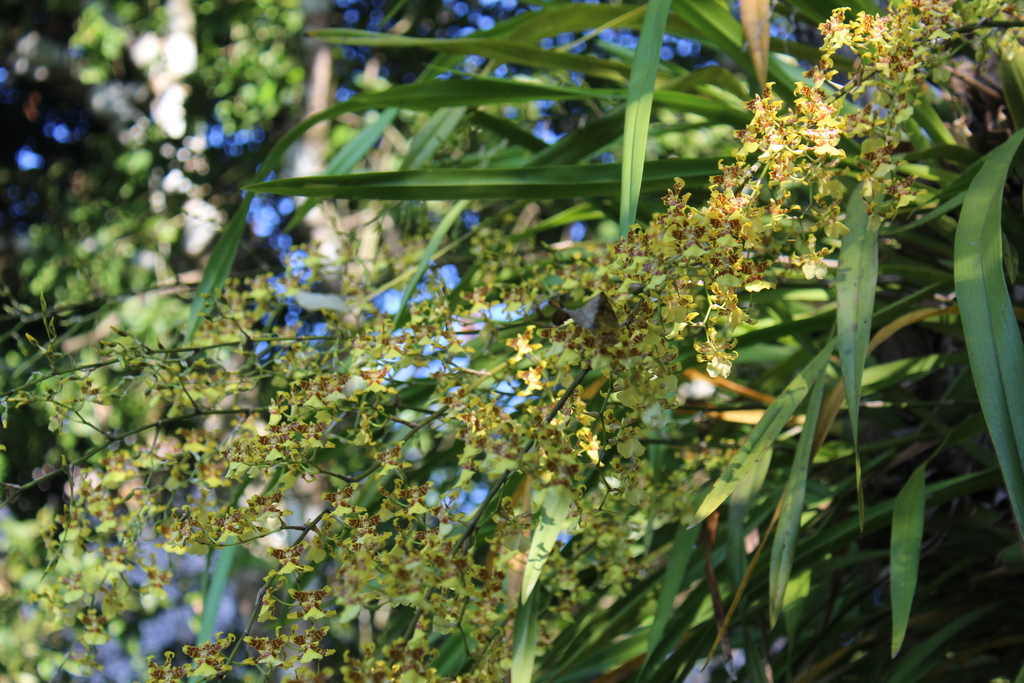
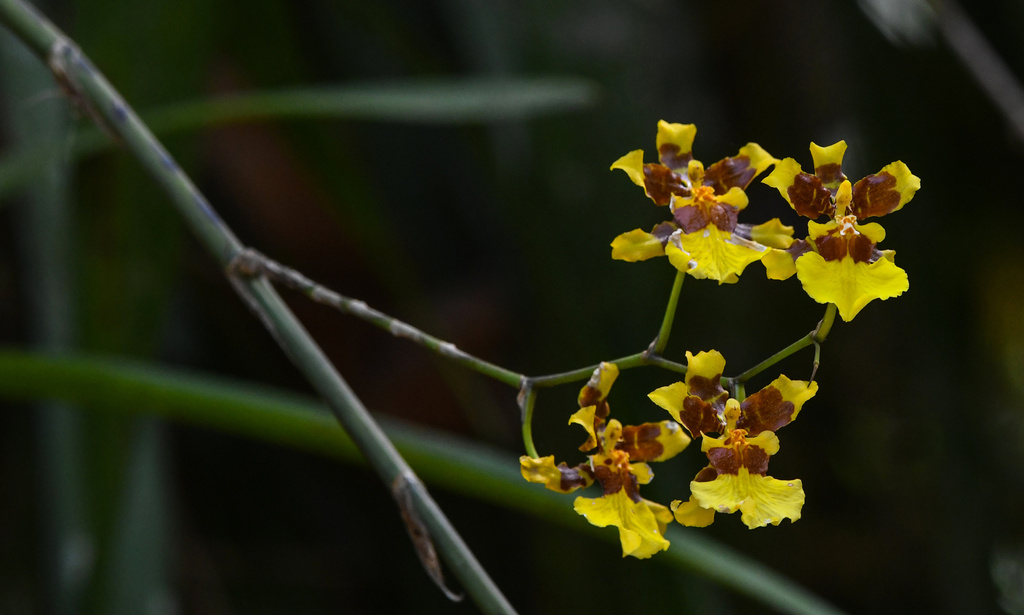
- It flowers on tall branching sprays from the base of a mature pseudobulb, often with dozens of small flowers at once.
- It wants bright indirect light. More than a phalaenopsis, less than a cattleya or vanda.
- Non-toxic to cats and dogs.
Care requirements#
| Plant type | Epiphytic orchid grown mounted; outdoors year-round only in USDA 10-12 |
| Mounting substrate | Cork bark or tree fern slab with a modest sphagnum pad under the roots. More moss than a cattleya wants, less than a fern |
| Fixing method | Nylon cord or fishing line over the rhizome; never copper wire, never glue on living tissue |
| Light needs | Bright indirect light; more than a phalaenopsis, less than a cattleya. Leaves should be light green |
| Watering method | Drench the mount thoroughly so the moss and roots are wet through, then let the surface dry |
| Soak-vs-mist schedule | Every 1-2 days in warm growing weather, every 3-4 days in winter; a morning mist between drenches helps in dry rooms |
| Drying window | The pad should feel barely damp, not bone dry, before the next watering. Oncidiums are less drought-tolerant than cattleyas |
| Air circulation | Important; steady airflow prevents black spot on the thin leaves |
| Humidity | 50-70%; below 40% mounted oncidiums struggle badly |
| Temperature range | 16-29°C (60-85°F) for most hybrids, with a modest night drop |
| Fertilizer | Quarter-strength orchid feed with most waterings in growth, flushed with plain water weekly |
| Toxicity | Non-toxic to cats, dogs, and humans |
Growth & propagation#
| Mature size | 30-60cm of foliage with flower sprays reaching a metre on larger hybrids |
| Growth rate | Moderate to fast. Usually one or two new pseudobulbs a year |
| Flowering | Sprays of many small flowers from the base of a mature pseudobulb, often in autumn |
| Propagation methods | Division of the clump, keeping at least three pseudobulbs per piece |
| Propagation difficulty | Moderate: divide as new roots start and remount straight away |
| Pruning needs | Cut spent flower spikes at the base; remove only shrivelled, leafless brown back-bulbs |
Common problems & troubleshooting#
| Symptom | Likely cause | Fix |
|---|---|---|
| New leaves emerge pleated like an accordion | The plant dried out or lost roots while the growth was forming | Water more frequently and raise humidity; the pleated leaf stays pleated, but the next growth will be smooth |
| Black spots spreading on leaves | Fungal or bacterial leaf spot in still, damp conditions | Improve airflow, water in the morning so leaves dry, and remove badly affected leaves |
| Pseudobulbs wrinkle and roots look brittle | Chronic under-watering on a fast-drying mount | Increase watering to daily in warm weather and add a slightly larger sphagnum pad at remount |
| No flower spikes despite healthy growth | Too little light, or pseudobulbs not reaching full maturity | Increase to brighter indirect light and feed consistently through the growing season |
| Root tips blacken and stop growing | Fertiliser salt build-up on a mount that is never flushed | Flush the mount with plain water weekly and reduce feed concentration |
Fine roots dry out before you notice
Sodate builds a watering cadence around how fast your mount actually dries, so new growths never come out pleated.
Seasonal care#
Varieties & cultivars#
| Variety | Distinguishing trait | Note |
|---|---|---|
| Oncidium 'Sharry Baby' | Chocolate-scented burgundy and white flowers | The best-known hybrid; vigorous and forgiving |
| Oncidium Twinkle hybrids | Miniature plants with masses of tiny fragrant flowers | Ideal size for small cork mounts |
| Oncidium flexuosum | Species with wiry sprays of bright yellow flowers | Spreads readily across a mount |
| Oncidium (Tolumnia) equitant types | Tiny fan-shaped plants with no real pseudobulbs | Must be mounted bare and dry fast; not for pots |
Buying checklist#
- Pseudobulbs plump and smooth, not deeply grooved
- Newest leaf is smooth rather than pleated, showing it was watered adequately
- Live white root tips visible on the mount
- No spreading black leaf spot, which travels quickly in the genus
Pricing by region#
| Region | Price range | Typical unit | Basis |
|---|---|---|---|
| US | $20 – $60 | blooming-size mounted plant | Orchid nursery + online |
| UK | $25 – $70 | blooming-size mounted plant | Specialist orchid nursery |
| India | $7 – $28 | blooming-size plant | Orchid nurseries |
| Australia | $22 – $60 | blooming-size plant | Orchid society + nursery sales |
| Canada | $25 – $70 | blooming-size plant | Orchid nursery + online |
USD figures are approximate conversions for comparison; switch the dropdown to see each region's actual local-currency listing price.
Often confused with#
Name confusion warning#
Many former Oncidium species are now placed in Tolumnia, Gomesa or Trichocentrum. Tolumnia in particular needs a much drier, bare mount, so check which group your plant belongs to before applying general oncidium watering.
Where it's actually grown#
Commercial oncidiums are cloned and seed-raised by orchid nurseries in Taiwan, Thailand, Hawaii and Florida for the pot-plant trade; mounted plants are almost always nursery stock remounted by specialists.
Import & biosecurity restrictions#
| Region | Note |
|---|---|
| Australia | Live plant imports restricted under biosecurity law; buy from domestic orchid nurseries and society sales. |
| US | All orchids are CITES-listed, so imports need CITES paperwork; nursery-propagated plants sold domestically are unrestricted. |
| UK | CITES documentation required for import; widely available from domestic orchid specialists. |
| India | No restriction on domestic sale; grown commercially in the northeast and in Kerala. |
| Canada | CITES permits plus CFIA import requirements apply; retail plants are unrestricted. |
Similar plants
Ranked in these guides
Did you know?
Frequently asked questions
Why are my oncidium's new leaves pleated?
Accordion pleating means the plant ran short of water or lost roots while that leaf was expanding. The pleated leaf stays that way, but fixing the watering means the next growth comes out smooth.
How often should I water a mounted oncidium?
Every one to two days in warm growing weather and every three to four days in winter. Fine oncidium roots dry faster than a cattleya's, so mounts need frequent attention.
How much light does an oncidium need?
Bright indirect light. More than a phalaenopsis but less than a cattleya or vanda. Leaves should be a light green.
Are oncidium orchids safe for pets?
Yes, oncidiums and orchids generally are non-toxic to cats and dogs.
How much does a mounted oncidium cost?
Blooming-size mounted plants typically run $20-$60 in the US, with named fragrant hybrids at the upper end.