 Sodate
On this page
Here is the contrast that trips people up: almost every tillandsia is grown bare with no medium at all, but T. cyanea is a potted plant. It has functional roots and is grown in an open, fast-draining bromeliad or orchid mix, watered into the pot rather than soaked in a bowl. The pink paddle bract lasts two to three months while violet flowers open one by one, then the rosette declines and pups take over. Pet-safe. Typically $10-$25.
Key facts
- Unlike nearly all other tillandsias, T. cyanea is grown in a pot with an open bromeliad or orchid mix. It has genuine functioning roots, not just holdfasts.
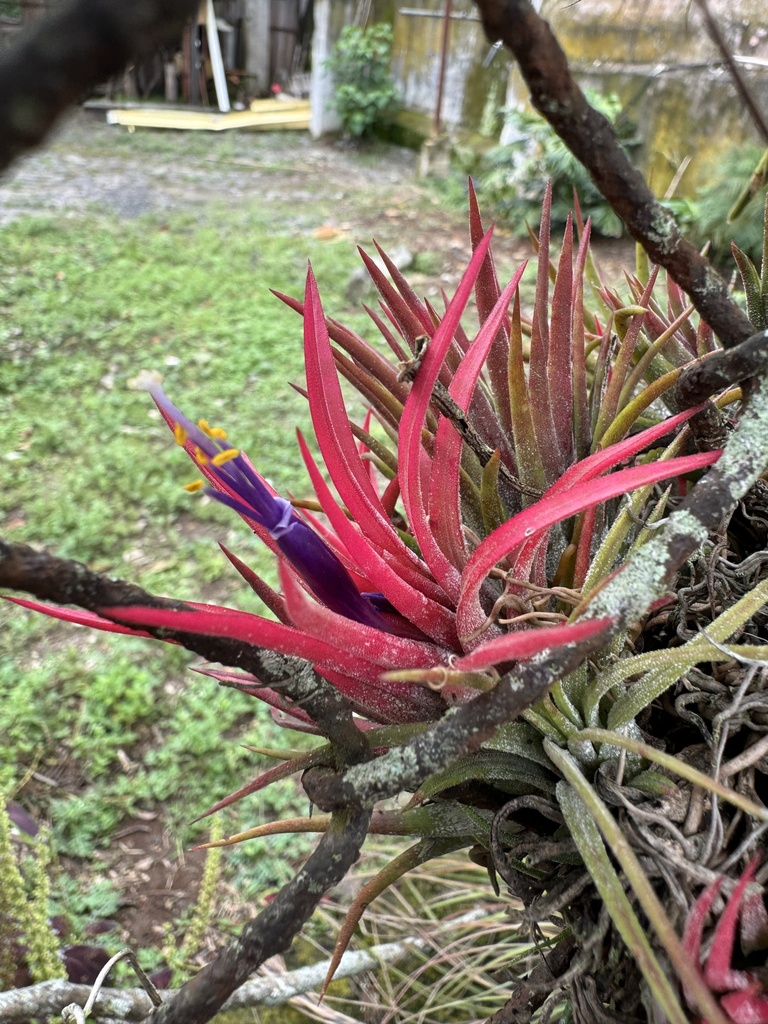
- The flat pink 'quill' is a bract, not a flower; the actual violet flowers emerge from its edges one or two at a time over two to three months.
- Do not soak it upside down in a bowl the way you would an ionantha; water the mix and let it drain.
- It is monocarpic like other tillandsias. The flowered rosette slowly declines while pups grow to replace it.
- Non-toxic to cats and dogs.
Care requirements#
| Plant type | Epiphytic bromeliad, but grown potted indoors; outdoors year-round only in USDA 10-11 |
| Growing medium | Open, fast-draining bromeliad or orchid mix. Bark, perlite and a little peat. Not standard potting soil |
| Contrast with other tillandsias | Most tillandsias are grown bare with no medium; this one is a genuine pot plant with functional roots |
| Light needs | Bright indirect light; a little gentle morning sun deepens the bract colour, harsh midday sun scorches leaves |
| Watering method | Water into the mix until it drains, and keep a little water in the central cup in warm weather |
| Soak-vs-mist schedule | Water roughly weekly and let the top of the mix dry between waterings. Never soak-and-invert the plant like an air plant |
| Water quality | Rainwater or filtered water preferred; hard tap water marks the leaves and bract |
| Air circulation | Good airflow helps, especially if you keep water in the central cup |
| Humidity | 50-70% preferred; brown leaf tips are the first sign the air is too dry |
| Temperature range | 16-27°C (60-80°F); protect from cold draughts and never below 10°C |
| Fertilizer | Quarter-strength bromeliad feed monthly in spring and summer, applied to the mix |
| Toxicity | Non-toxic to cats, dogs, and humans |
Growth & propagation#
| Mature size | 30-40cm wide rosette of narrow arching leaves, bract held just above the foliage |
| Growth rate | Moderate: takes two to three years from pup to flowering size |
| Bloom cycle | One pink bract per rosette, producing violet flowers over two to three months, then the rosette declines |
| Propagation methods | Pups at the base after flowering; separate at about a third of the mother's size and pot in bromeliad mix |
| Propagation difficulty | Easy: pups come away cleanly with a sharp knife |
| Repotting schedule | Every 2-3 years, or when potting up separated pups; use a snug pot with fast drainage |
Common problems & troubleshooting#
| Symptom | Likely cause | Fix |
|---|---|---|
| Base rots and the rosette collapses | Grown in dense potting soil or watered like a normal houseplant | Repot into open bromeliad or orchid mix and let the surface dry between waterings |
| Pink bract fades to pale green or tan | Natural end of the bract's two to three month display, or too little light | Nothing to fix if the display simply ran its course; brighter light gives stronger colour on the next generation |
| Brown crispy leaf tips | Dry air or hard tap water salts | Raise humidity and switch to rainwater or filtered water |
| Plant declines after flowering | Normal monocarpic life cycle | Keep watering while the pups develop, then pot the pups up and discard the spent rosette |
| No bract after several years | Insufficient light, or the plant is not yet mature | Move to a brighter position; it needs bright indirect light to reach flowering size |
The tillandsia that breaks the tillandsia rules
Sodate keeps species-specific care straight, so you don't soak a potted pink quill or pot up an air plant.
Seasonal care#
Varieties & cultivars#
| Variety | Distinguishing trait | Note |
|---|---|---|
| T. cyanea (species) | Classic flat pink bract with violet flowers | The standard form in the houseplant trade |
| T. cyanea 'Anita' | Broader, more richly coloured bract, compact habit | Actually a hybrid; the most common plant sold as pink quill |
| Tillandsia lindenii | Larger bract on a longer stalk with a white flower eye | A close relative frequently sold under the cyanea name |
Buying checklist#
- Bract is firm and strongly coloured, with flower buds still to open along its edge
- Rosette base is firm with no soft brown tissue
- Potting mix is open and bark-based rather than dense wet soil
- Look for pups already forming at the base if you want the plant to continue after flowering
Pricing by region#
| Region | Price range | Typical unit | Basis |
|---|---|---|---|
| US | $10 – $25 | 4-6in potted plant in bract | Garden centre + online |
| UK | $10 – $25 | 12cm potted plant | Garden centre retail |
| India | $4 – $12 | potted plant | Urban nursery + online |
| Australia | $11 – $28 | 125mm potted plant | Nursery retail |
| Canada | $12 – $28 | 4-6in potted plant | Garden centre + online |
USD figures are approximate conversions for comparison; switch the dropdown to see each region's actual local-currency listing price.
Often confused with#
Name confusion warning#
Most plants sold as Tillandsia cyanea in shops are actually the hybrid 'Anita' or the closely related T. lindenii. Care is the same for all three, and all of them are potted rather than mounted.
Where it's actually grown#
Commercial pink quills are mass-produced from tissue culture and pups by bromeliad nurseries in the Netherlands, Florida, Costa Rica and Thailand; the wild Ecuadorian species is rarely collected for trade.
Import & biosecurity restrictions#
| Region | Note |
|---|---|
| Australia | Live plant imports restricted under biosecurity law; widely available from domestic bromeliad nurseries. |
| US | No restriction on domestic sale; Tillandsia cyanea is not CITES-listed. |
| UK | Imports need phytosanitary paperwork; a standard garden centre houseplant domestically. |
| India | No specific restriction; sold by urban nurseries, best in bright but not hot indoor spots. |
| Canada | CFIA permits required for commercial imports; readily available at retail. |
Similar plants
Ranked in these guides
Did you know?
Frequently asked questions
Is Tillandsia cyanea an air plant?
It is a tillandsia, but unlike almost all the others it is grown in a pot of open bromeliad mix with functioning roots rather than bare on a mount.
Should I soak a pink quill plant like other air plants?
No. Water it into the pot until the mix drains, roughly weekly. Soaking and inverting it the way you would an ionantha risks rotting the potted base.
How long does the pink bract last?
Two to three months, with violet flowers opening one or two at a time along its edges, after which the bract fades.
Is the pink quill plant safe for cats and dogs?
Yes, tillandsias including T. cyanea are non-toxic to cats and dogs.
What do I do after my pink quill finishes flowering?
The flowered rosette slowly declines, which is normal. Keep watering while pups grow at the base, then separate and pot them once they reach about a third of the mother's size.